Windows Vista is the latest release of Microsoft Windows, a line of graphical operating systems used on personal computers, including home and business desktops. Prior to its announcement on July 22, 2005, Vista was known by its codename Longhorn.[1] On November 8, 2006, Windows Vista development was completed and released to manufacturing. Over the next two months it was released to MSDN, TechNet Plus and TechNet Direct subscribers, computer hardware and software manufacturers and volume license customers. On January 30, 2007, it was released worldwide to the general public,[2] and is available for purchase and downloading from Microsoft's web site.[3] These release dates come more than five years after the release of its predecessor, Windows XP, making it the longest time span between two releases of Windows versions.
According to Microsoft,[4] Windows Vista contains hundreds of new features; some of the most significant include an updated graphical user interface and visual style dubbed Windows Aero, improved searching features, new multimedia creation tools such as Windows DVD Maker, and completely redesigned networking, audio, print, and display sub-systems. Vista also aims to increase the level of communication between machines on a home network using peer-to-peer technology, making it easier to share files and digital media between computers and devices. For developers, Vista introduces version 3.0 of the .NET Framework, which aims to make it significantly easier for developers to write high-quality applications than with the traditional Windows API.
Microsoft's primary stated objective with Vista, however, has been to improve the state of security in the Windows operating system.[5] One common criticism of Windows XP and its predecessors has been their commonly exploited security vulnerabilities and overall susceptibility to malware, viruses and buffer overflows. In light of this, then Microsoft chairman Bill Gates announced in early 2002 a company-wide 'Trustworthy Computing initiative' which aims to incorporate security work into every aspect of software development at the company. Microsoft claimed that it prioritized improving the security of Windows XP and Windows Server 2003 above finishing Windows Vista, significantly delaying its completion.[6]
During the course of its development, Vista has been the target of a number of negative assessments by various groups. Criticism of Windows Vista has included protracted development time, more restrictive licensing terms, the inclusion of a number of new Digital Rights Management technologies aimed at restricting the copying of protected digital media, and the usability of new features such as User Account Control.
[edit] Development

The Windows Vista Codename (Longhorn) logo
-
Microsoft started work on their plans for "Longhorn" in May 2001,[7] prior to the release of Windows XP. It was originally expected to ship sometime late in 2003 as a minor step between Windows XP (codenamed "Whistler") and "Blackcomb" (now known as Windows "Vienna"). Gradually, "Longhorn" assimilated many of the important new features and technologies slated for "Blackcomb," resulting in the release date being pushed back a few times. Many of Microsoft's developers were also re-tasked with improving the security of Windows XP.[6] Faced with ongoing delays and concerns about feature creep, Microsoft announced on August 27, 2004 that it was making significant changes. "Longhorn" development basically started afresh, building on the Windows Server 2003 codebase, and re-incorporating only the features that would be intended for an actual operating system release. Some previously announced features, such as WinFS and NGSCB, were dropped or postponed, and a new software development methodology called the "Security Development Lifecycle" was incorporated in an effort to address concerns with the security of the Windows codebase.[8]
After "Longhorn" was named Windows Vista, an unprecedented beta-test program was started, which involved hundreds of thousands of volunteers and companies. In September 2005, Microsoft started releasing regular Community Technology Previews (CTP) to beta testers. The first of these was distributed among 2005 Microsoft Professional Developers Conference attendees, and was subsequently released to Microsoft Beta testers and Microsoft Developer Network subscribers. The builds that followed incorporated most of the planned features for the final product, as well as a number of changes to the user interface, based largely on feedback from beta testers. Windows Vista was deemed feature-complete with the release of the "February CTP," released on February 22, 2006, and much of the remainder of work between that build and the final release of the product focused on stability, performance, application and driver compatibility, and documentation. Beta 2, released in late May, was the first build to be made available to the general public through Microsoft's Customer Preview Program. It was downloaded by over five million people. Two release candidates followed in September and October, both of which were made available to a large number of users.
While Microsoft had originally hoped to have the operating system available worldwide in time for Christmas 2006, it was announced in March 2006 that the release date would be pushed back to January 2007, so as to give the company – and the hardware and software companies which Microsoft depends on for providing device drivers – additional time to prepare. Through much of 2006, analysts and bloggers had speculated that Windows Vista would be delayed further, owing to anti-trust concerns raised by the European Commission and South Korea, and due to a perceived lack of progress with the beta releases. However, with the November 8, 2006 announcement of the completion of Windows Vista, Microsoft's most lengthy operating system development project came to an end.
[edit] New or altered features
-
[edit] End-user features
- Windows Aero: a new hardware-based graphical user interface, named Windows Aero – an acronym (possibly a backronym) for Authentic, Energetic, Reflective, and Open. The new interface is intended to be cleaner and more aesthetically pleasing than those of previous Windows, including new transparencies, live thumbnails, live icons, animations and eye candy.
- Windows Shell: The new Windows shell is significantly different from Windows XP, offering a new range of organization, navigation, and search capabilities. Windows Explorer's task pane has been removed, integrating the relevant task options into the toolbar. A "Favorite links" pane has been added, enabling one-click access to common directories. The address bar has been replaced with a breadcrumb navigation system. The preview panel allows you to see thumbnails of all sorts of files and view the contents of documents, similar to the way you can preview email messages in Outlook, without opening the files. The Start menu has changed as well; it no longer uses ever-expanding boxes when navigating through Programs. Even the word "Start" itself has been removed in favor of a blue Windows Orb (also called "Pearl").
- Windows Search (also known as Instant Search or search as you type): significantly faster and more thorough search capabilities. Search boxes have been added to the Start menu, Windows Explorer, and several of the applications included with Vista. By default, Instant Search indexes only a small number of folders such as the start menu, the names of files opened, the Documents folder, and the user's e-mail. Advanced options allow to choose for a specific file type how it should be indexed, the properties only or the properties and the file contents or exclude it.
- Windows Sidebar: A transparent panel anchored to the side of the screen where a user can place Desktop Gadgets, which are small applets designed for a specialized purpose (such as displaying the weather or sports scores). Gadgets can also be placed on other parts of the Desktop, if desired.
- Windows Internet Explorer 7: new user interface, tabbed browsing, RSS, a search box, improved printing, Page Zoom, Quick Tabs (thumbnails of all open tabs), Anti-Phishing filter, a number of new security protection features, Internationalized Domain Name support (IDN), and improved web standards support. IE7 in Windows Vista runs in isolation from other applications in the operating system (protected mode); exploits and malicious software are restricted from writing to any location beyond Temporary Internet Files without explicit user consent.
- Windows Media Player 11, a major revamp of Microsoft's program for playing and organizing music and video. New features in this version include word wheeling (or "search as you type"), a completely new and highly graphical interface for the media library, photo display and organization, and the ability to share music libraries over a network with other Vista machines, Xbox 360 integration, and support for other Media Center Extenders.
- Backup and Restore Center: Includes a backup and restore application that gives users the ability to schedule periodic backups of files on their computer, as well as recovery from previous backups. Backups are incremental, storing only the changes each time, minimizing the disk usage. It also features CompletePC Backup (available only to Ultimate, Business, and Enterprise versions) which backs up an entire computer as an image onto a hard disk or DVD. CompletePC Backup can automatically recreate a machine setup onto new hardware or hard disk in case of any hardware failures.
- Windows Mail: A replacement for Outlook Express that includes a new mail store that improves stability, and enables real-time search. It has the Phishing Filter like IE7 and a Junk mail filtering which is enhanced through regular updates via Windows Update.[9]
- Windows Calendar is a new calendar and task application.
- Windows Photo Gallery, a photo and movie library management application. WPG can import from digital cameras, tag and rate individual items, adjust colors and exposure, create and display slideshows (with pan and fade effects), and burn slideshows to DVD.
- Windows DVD Maker, a companion program to Windows Movie Maker, which provides the ability to create video DVDs based on a user's content.
- Windows Meeting Space is the replacement for NetMeeting. Users can share applications (or their entire Desktop) with other users on the local network, or over the Internet using peer-to-peer technology (higher versions than Starter and Home Basic can take advantage of hosting capabilities, limiting previous to "join" mode only)
- Windows Media Center, which was previously exclusively bundled as a separate version of Windows XP, known as Windows XP Media Center Edition, will be incorporated into the Home Premium and Ultimate editions of Windows Vista.
- Games: Games included with Windows have been modified to work with Vista's graphics capabilities. New games include Chess Titans, Mahjong Titans and Purble Place. The Games section will also hold links and information to all games on the user's computer. One piece of information that will be shown is the game's ESRB rating.
- Previous Versions automatically creates backup copies of files and folders, with daily frequency. Users can also create "shadow copies" by setting a System Protection Point using the System Protection tab in the System control panel. The user can be presented multiple versions of a file throughout a limited history and be allowed to restore, delete, or copy those versions. This feature is available only in the Business, Enterprise, and Ultimate editions of Windows Vista and is inherited from Windows Server 2003.[10]
- Windows Mobility Center is a new control panel that centralizes the most relevant information related to mobile computing (e.g. brightness, sound, battery level / power scheme selection, wireless network, screen orientation, presentation settings, etc.).
- Windows Update: Software and security updates have been simplified, now operating solely via a control panel instead of as a web application. Mail's spam filter and Defender's definitions will also be automatically updated via Windows Update.
- Parental controls: Allows administrators to control which websites, programs, and games each standard user can use and install.
- Windows SideShow: Enables the auxiliary displays on newer laptops or on supported Windows Mobile devices. It is meant to be used to display Device gadgets while the computer is on or off.
- Speech recognition is fully integrated into Vista. It is an improved version of Microsoft Speech Recognition currently working under Office 2003, with a redesigned interface, a flexible set of commands, and an command-and-control capability to activate the computer by voice. Unlike the Office 2003 version, which works only in Office and WordPad, it works for dictation system-wide. In addition, it currently supports several languages: English US and UK, Spanish, French, German, Chinese (Traditional and Simplified), and Japanese.
- New fonts, including several designed especially for screen reading, and new high-quality Chinese (Yahei, JhengHei), Japanese (Meiryo) and Korean (Malgun) fonts. See Windows Vista typefaces. ClearType has also been enhanced and enabled by default.
- Problem Reports and Solutions, a new control panel which allows users to see previously sent problems and any solutions or additional information that is available.
- Improved audio controls allow the system-wide volume or volume of individual audio devices and even individual applications to be controlled separately. Introduced new audio functionalities such as Room Correction, Bass Management, Speaker Fill and Headphone virtualization.
- System Performance Assessment is a benchmark used by Windows Vista to regulate the system for optimum performance. Games can take advantage of this feature, reading the data produced by this benchmark in order to fine-tune the game details. The benchmark tests CPU, RAM, Graphics acceleration (2D and 3D) and disk access.[11]
- Windows Ultimate Extras: The Ultimate Edition of Windows Vista provides access to extra games and tools, available through Windows Update. This replaces the Microsoft Plus! software bundle that was sold alongside prior versions of Windows.
- Built-in hard drive partition management: A utility to modify hard disk drive partitions, including shrinking, creating and formating new partitions.
[edit] Core technologies
Windows Vista is intended to be a technology-based release, to provide a solid base to include technologies, many of which will be related to how the system functions, and hence not readily visible to the user. An example of this is the restructuring of the architecture of the audio, print, display, and networking subsystems; while the results of this work will be visible to software developers, end-users will only see what appear to be evolutionary changes in the user interface.
Vista includes technologies such as ReadyBoost and ReadyDrive which employ fast flash memory (located on USB drives and hybrid hard disk drives respectively) to improve system performance by caching commonly-used programs and data. This manifests itself in improved battery life on notebook computers as well, since a hybrid drive can be spun down when not in use. Another new technology called SuperFetch utilizes machine learning techniques to analyze usage patterns in order to allow Windows Vista to make decisions about what content should be present in system memory at any given time.
As part of the redesign of the networking architecture, IPv6 has been incorporated into the operating system, and a number of performance improvements have been introduced, such as TCP window scaling. Prior versions of Windows typically needed third-party wireless networking software to work properly; this is no longer the case with Vista, as it includes more comprehensive wireless networking support.
For graphics, Vista introduces a new Windows Display Driver Model, as well as major revisions to Direct3D. The new driver model facilitates the new Desktop Window Manager, which provides the tearing-free desktop and special effects that are the cornerstones of Windows Aero. WDDM's current version 1.0 is able to offload rudimentary tasks to the GPU, driver installation no longer requires a system reboot and seamless recovery from rare driver errors due to illegal application behavior. The next version is going to require an entirely new generation of GPUs, which nVidia and ATI are working on. Direct3D 10, developed in conjunction with major display driver manufacturers, is a new architecture with more advanced shader support, and allows the graphics processing unit to render more complex scenes without assistance from the CPU. It features improved load balancing between CPU and GPU and also optimizes data transfer between them.[12]
At the core of the operating system, many improvements have been made to the memory manager, process scheduler, heap manager, and I/O scheduler. A Kernel Transaction Manager has been implemented that gives applications the ability to work with the file system and registry using atomic transaction operations.
[edit] Security-related technologies

A User Account Control consent dialog.
-
Improved security was a primary design goal for Vista.[5] Microsoft's Trustworthy Computing initiative, which aims to improve public trust in its products, has had a direct effect on its development. This effort has resulted in a number of new security and safety features.
User Account Control is perhaps the most significant and visible of these changes. User Account Control is a security technology that makes it possible for users to use their computer with fewer privileges by default. This was often difficult in previous versions of Windows, as the previous "limited" user accounts proved too restrictive and incompatible with a large proportion of application software, and even prevented some basic operations such as looking at the calendar from the notification tray. In Windows Vista, when an action requiring administrative rights is requested, the user will be first prompted for an administrator name and password; in cases where the user is already an administrator, the user is still prompted to confirm the pending privileged action. User Account Control asks for credentials in a Secure Desktop mode, where the entire screen is blacked out, temporarily disabled, and only the authorization window is active and highlighted. The intent is to stop a malicious program 'spoofing' the user interface, attempting to capture admin credentials.
Another significant new feature is BitLocker Drive Encryption, a data protection feature included in the Enterprise and Ultimate editions of Vista that provides encryption for the entire operating system volume. Bitlocker can work in conjunction with a Trusted Platform Module chip (version 1.2) that is on a computer's motherboard, or with a USB key.[13]
Microsoft's anti-spyware product, Windows Defender, has been incorporated into Windows, providing protection against malware and other threats. Changes to various system configuration settings (such as new auto-starting applications) are blocked unless the user gives consent.
Internet Explorer 7's new security and safety features include a phishing filter, IDN with anti-spoofing capabilities, and integration with system-wide parental controls. For added security, ActiveX controls are disabled by default. Also, Internet Explorer operates in a "protected mode" which operates with lower permissions than the user and it runs in isolation from other applications in the operating system, preventing it from accessing or modifying anything besides the Temporary Internet Files directory.[14] Also, Internet Explorer is no longer integrated with the Explorer shell; local files typed in IE are opened using the Explorer shell and Web sites typed in Explorer are opened using the default web browser.
A variety of other privilege-restriction techniques are also built into Vista. An example is the concept of "integrity levels" in user processes, whereby a process with a lower integrity level cannot interact with processes of a higher integrity level. The security restrictions of Windows services are more fine-grained, so that services (especially those listening on the network) have no ability to interact with parts of the operating sytem they do not need to. Obfuscation techniques such as address space layout randomization and Kernel Patch Protection are used to increase the amount of effort required of malware before successful infiltration of a system.
As part of the redesign of the network stack, Windows Firewall has been upgraded, with new support for filtering both incoming and outgoing traffic. Advanced packet filter rules can be created which can grant or deny communications to specific services. Vista also adds new SSL and TLS cryptographic extensions, which enable support for both AES and some of the new ECC cipher suites.
[edit] Business technologies
While much of the focus of Vista's new capabilities has been on the new user interface, security technologies, and improvements to the core operating system, Microsoft is also adding new deployment and maintenance features.
- The WIM image format (Windows IMage) is the cornerstone of Microsoft's new deployment and packaging system. WIM files, which contain an image of Windows Vista, can be maintained and patched without having to rebuild new images. Windows Images can be delivered via Systems Management Server or Business Desktop Deployment technologies. Images can be customized and configured with applications then deployed to corporate client personal computers using little to no touch by a system administrator. ImageX is the Microsoft tool used to create and customize images.
- Windows Deployment Services replaces Remote Installation Services for deploying Vista and prior versions of Windows.
- Approximately 700 new Group Policy settings have been added, covering most aspects of the new features in the operating system, as well as significantly expanding the configurability of wireless networks, removable storage devices, and user desktop experience.[15]
- Services for UNIX has been renamed "Subsystem for UNIX-based Applications," and is included with the Enterprise and Ultimate editions of Vista. Network File System (NFS) client support is also included.
- Multi-lingual User Interface - Unlike previous version of Windows which required language packs to be loaded to provide local language support, Windows Vista Enterprise edition supports the ability to dynamically change languages based on the logged on user's preference.
- Wireless Projector support
[edit] Developer technologies
Windows Vista includes a large number of new application programming interfaces. Chief among them is the inclusion of version 3.0 of the .NET Framework, which consists of a class library and Common Language Runtime. Version 3.0 includes four new major components:[16]
These technologies will also be available for Windows XP and Windows Server 2003 to facilitate their introduction to and usage by developers and end users.
There are also significant new development APIs in the core of the operating system, notably the completely re-architected audio, networking, print, and video interfaces, major changes to the security infrastructure, improvements to the deployment and installation of applications ("ClickOnce" and Windows Installer 4.0), new device driver development model ("Windows Driver Foundation"), Transactional NTFS, mobile computing API advancements (power management, Tablet PC Ink support, SideShow) and major updates to (or complete replacements of) many core subsystems such as Winlogon and CAPI.
There are some issues for software developers using some of the graphics APIs in Vista. Games or programs which are built on Vista's version of DirectX, 10, will not work on prior versions of Windows, as DirectX 10 is not backwards-compatible with DirectX 9.[17] According to a Microsoft blog, there are three choices for OpenGL implementation on Vista. An application can use the default implementation, which translates OpenGL calls into the Direct3D API and is frozen at OpenGL version 1.4, or an application can use an Installable Client Driver (ICD), which comes in two flavors: legacy and Vista-compatible. A legacy ICD, the kind already provided by independent hardware vendors targeting Windows XP, will disable the Desktop Window Manager, noticeably degrading user experience under Windows Aero. A Vista-compatible ICD takes advantage of a new API, and will be fully compatible with the Desktop Window Manager.[18] At least two primary vendors, ATI and NVIDIA, are expected to provide full Vista-compatible ICDs in the near future.[19] However, hardware overlay is not supported, because it is considered as an obsolete feature in Vista. ATI and NVIDIA strongly recommend using compositing desktop/FBOs for same functionality.[20]
[edit] Deprecated features
Some notable Windows XP features and components have been replaced or removed in Windows Vista, including Windows Messenger, the network Messenger Service, HyperTerminal, MSN Explorer, and the replacement of NetMeeting with Windows Meeting Space. Windows Vista also does not include the Windows XP "Luna" visual theme, or most of the classic color schemes which have been part of Windows since the Windows 3.x era. The "Hardware profiles" startup feature has been removed as well, along with support for older motherboard technologies like the EISA bus and APM. IP over 1394 (TCP/IP over IEEE 1394) has been removed.[2]
WinHlp32.exe, used to display 32-bit .hlp files, is no longer included in Windows Vista as Microsoft considers it obsolete.[21] Existing programs that can work with Vista are not able to display Help documentation on Vista. Microsoft prohibits software manufacturers from re-introducing the .hlp help system with their products. Microsoft claimed in the above referenced support bulletin that WinHlp32.exe would be available "in time for the consumer release of Windows Vista scheduled for early 2007" from Microsoft's Download Center. As of 18 February 2007, no .hlp download is available.
Telnet.exe is no longer installed by default, but is still included as an installable feature.[22]
[edit] Editions and pricing
-

Windows Vista Home Basic Upgrade Edition - Full English Contents
Windows Vista ships in six editions.[23] These editions are roughly divided into two target markets, consumer and business, with editions varying to cater for specific sub-markets. For consumers, there are four editions, with three available for Western countries; Windows Vista Starter is limited to emerging markets. Windows Vista Home Basic is intended for budget users with low needs. Windows Vista Home Premium covers the majority of the consumer market. Windows Vista Ultimate contains the complete feature-set and is aimed at enthusiasts. For businesses, there are two versions. Windows Vista Business covers organisations of all sizes, while Windows Vista Enterprise is only available to customers participating in Microsoft's Software Assurance program.
All editions except Windows Vista Starter support both processor architectures, 32-bit (x86) and 64-bit (x86-64), while Windows Vista Starter is only available for 32-bit architectures. In the European Union, Home Basic N and Business N versions will also be available. These versions come without Windows Media Player, due to EU sanctions brought against Microsoft for violating anti-trust laws. Similar sanctions exist in South Korea.
On September 5, 2006, USD pricing was announced for the four editions that are available through retail channels.[24] New license and upgrade license SKUs of each edition are available.
Microsoft states that the packaging for the retail editions of Windows Vista is "designed to be user-friendly, and the new packaging is a hard plastic container that will protect the software inside for life-long use".[25] The case opens sideways to reveal the Windows Vista DVD suspended in a clear plastic case. The Windows Vista disc itself uses a holographic design similar to the discs that Microsoft has produced since Windows 2000.
[edit] Visual styles
Windows Vista has four distinct visual styles.[26]
- Windows Aero
-
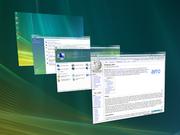
Windows Flip 3D (Win+Tab keys)

Windows Flip (Alt+Tab keys)

Live Thumbnails (Win+T keys)
- Vista's premier visual style is built on a new desktop composition engine called Desktop Window Manager. Windows Aero introduces support for 3D graphics (Windows Flip 3D), translucency effects (Glass), live thumbnails, window animations, and other visual effects, and is intended for mainstream and high-end graphics cards. To enable these features, the contents of every open window is stored in video memory to facilitate tearing-free movement of windows. As such, Windows Aero has significantly higher hardware requirements than its predecessors. 128 MB of graphics memory is the minimum requirement, depending on resolution used.[27] Windows Aero (including Windows Flip 3D) is not included in the Starter and Home Basic editions.
- Windows Vista Standard
- This mode is a variation of Windows Aero without the glass effects, window animations, and other advanced graphical effects such as Windows Flip 3D. Like Windows Aero, it uses the Desktop Window Manager, and has generally the same video hardware requirements as Windows Aero. This is the default mode for the Windows Vista Home Basic Edition. The Starter (developing markets) edition does not support this mode.
- Windows Vista Basic
- This mode has aspects that are similar to Windows XP's visual style with the addition of subtle animations such as those found on progress bars. It does not employ the Desktop Window Manager; as such, it does not feature transparency or translucency, window animation, Windows Flip 3D or any of the functions provided by the DWM. The Basic mode does not require the new Windows Display Driver Model (WDDM) for display drivers, and has similar graphics card requirements to Windows XP. For computers with graphics cards that are not powerful enough to support Windows Aero, this is the default graphics mode.
- Windows Classic
- An option for corporate deployments and upgrades, Windows Classic has the look and feel of Windows 2000 and Windows Server 2003, does not use the Desktop Window Manager and does not require a WDDM driver. As with prior versions of Windows, this theme supports "Color schemes" which are a collection of color settings. Windows Vista includes six classic color schemes, comprised of four high-contrast color schemes, as well as the default colour schemes from Windows 98 and Windows 2000.

"Windows Aero" style. "Windows Vista Standard" is similar in appearance but without the glass effects around windows. | 
"Windows Vista Basic" visual style. | 
"Windows Classic" visual style. |
[edit] Hardware requirements

Windows Vista Capable sticker
According to Microsoft, computers capable of running Windows Vista are classified as Vista Capable and Vista Premium Ready.[28] A Vista Capable or equivalent PC needs to have at minimum an 800 MHz processor, 512 MB RAM and a DirectX 9 class graphics card. A computer that meets these requirements will be capable of running all editions of Windows Vista although some of the special features and high end graphics options may require additional or more advanced hardware. A Vista Premium Ready PC will take advantage of Vista's "high-end" features but will need at least a 1.0 GHz processor, 1 GB main memory, and an Aero-compatible graphics card with at least 128 MB graphics memory and supporting the new Windows Display Driver Model. The company also offers Windows Vista Upgrade Advisor[29] from its Web site to determine the ability of a PC to run Vista in its various guises. The utility runs on Windows XP (with Service Pack 2) and Windows Vista.
Microsoft lists some Vista capable hardware on their web site. The "Windows Vista Premium Ready" laptops they specify have Intel Core 2 Duo T5500 or above CPUs and 1 GB memory.[30]
Windows Vista comes with over 19,500 device drivers on the DVD (in contrast to just 10,000 for Windows XP when it shipped) and additional 11,700 device drivers on Windows Update (compared to just 2,000 for Windows XP when it RTM’d in 2001).
Windows Vista's "Basic" and "Classic" interfaces will work with virtually any graphics hardware that supports Windows XP or 2000; accordingly, most discussion around Vista's graphics requirements centers on those for the Windows Aero interface. As of Windows Vista Beta 2, the NVIDIA GeForce FX family and later, the ATI Radeon 9500 and later, Intel's GMA 950 integrated graphics, and a handful of VIA chipsets and S3 Graphics discrete chips are supported.[31] Though some XGI Technology Volari chips were DirectX 9 (including the Volari V3XT which was available in PCI cards), with XGI's exit from the graphics card business it appears none of its chips are supported as of Vista Beta 2. A PCI Express (PCIe) video card is not a requirement for Windows Aero, but Microsoft recommends PCIe video over an AGP device due to the interface's greater bandwidth.[32] There are some PCI cards available that are compatible with Windows Vista as well.
Windows Vista system requirements
| Vista Capable[27] | Vista Premium Ready[27] |
| Processor | 800 MHz | 1 GHz |
| Memory | 512 MB RAM | 1 GB RAM |
| Graphics card | DirectX 9 capable | DirectX 9 capable GPU with Hardware Pixel Shader v2.0 and WDDM driver support |
| Graphics memory | N/A | 128 MB RAM supports up to 2,756,000 total pixels (e.g. 1920 × 1200) or 512 MB+ for greater resolutions such as 2560x1600[33] |
| HDD capacity | 20 GB | 40 GB |
| HDD free space | 15 GB | 15 GB |
| Other drives | DVD-ROM | DVD-RW |
[edit] Criticism
-
Criticisms of Windows Vista include protracted development time, more restrictive licensing terms, the inclusion of a number of technologies aimed at restricting the copying of protected digital media, and the usability of the new User Account Control security technology. Reviewers have also noted similarities between Vista's Aero interface and that of Apple's Aqua interface for the Mac OS X operating system, particularly around the use of transition effects. Moreover, some concerns have been raised about many PCs meeting "Vista Premium Ready" hardware requirements and Vista's pricing.
- Licensing and cost
- The introduction of additional licensing restrictions has been criticized. Criticism of upgrade licenses pertaining to Windows Vista Starter through Home Premium was expressed by Ars Technica's Ken Fisher, who noted that the new requirement of having a prior operating system already installed was going to cause irritation for users who reinstall Windows on a regular basis.[34] It has been revealed that an Upgrade copy Windows Vista can be installed clean without first installing a previous version of Windows but Windows will refuse to activate, if the user then installs the same copy of Vista a second time it will activate on the reinstall allowing to install an Upgrade of Windows Vista without owning a previous operating system. [35] As with Windows XP, separate rules still apply to OEM versions of Vista installed on new PCs; these are not legally transferrable.[36] The cost of Windows Vista has also been a source of concern and commentary. A majority of users in a poll said that the prices of various Windows Vista editions posted on the Microsoft Canada website in August 2006 make the product too expensive.[37] A BBC News report on the day of Vista's release suggested that, "there may be a backlash from consumers over its pricing plans - with the cost of Vista versions in the US roughly half the price of equivalent versions in the UK."[38]
- Digital Rights Management
- Another common criticism concerns the integration of new forms of Digital Rights Management into the operating system, specifically the introduction of the Protected Video Path. This architecture is designed such that "premium content" from HD-DVD or Blu-ray discs may mandate that the connections between PC components be encrypted. Devices such as graphic cards must be approved by Microsoft. Depending on what the content demands, the devices may not pass premium content over non-encrypted outputs, or they must artificially degrade the quality of the signal on such outputs or not display it all. There is also a revocation mechanism that allows Microsoft to disable drivers of compromised devices in end-user PCs over the Internet.[39] Peter Gutmann, security researcher and author of the open source cryptlib library, claims that these mechanisms violate fundamental rights of the user (such as fair use), unnecessarily increase the cost of hardware, and make systems less reliable and vulnerable to denial-of-service attacks.[40] Proponents have claimed that Microsoft had no choice but to follow the demands of the movie studios, and that the technology will not actually be enabled until after 2010;[41][42] Microsoft also noted that content protection mechanisms have existed in Windows as far back as Windows Me, and that the new protections will not apply to any existing content (only future contents).[43]
- User Account Control
- Concerns have been raised about the new User Account Control security technology. While Yankee Group analyst Andrew Jaquith believes that critical security vulnerabilities may be "reduced by as much as 80 percent," he also noted that "while the new security system shows promise, it is far too chatty and annoying".[44] However, this statement was made over half a year before Vista was actually released (even before Beta 2 was released.)
- Kernel Patch Protection
- The Kernel Patch Protection feature (also known as "Patchguard") on 64-bit versions of Vista that locks down the OS kernel has been criticized by computer security company McAfee who claim that since PatchGuard also prevents third-party security companies from getting inside the OS, they cannot activate crucial security measures in their software to protect the OS from intruders.[45] Microsoft's argument is that this will keep miscreants out of the OS and prevent the incidence of attacks, and it is something for which customers have been asking. Security vendor Kaspersky Lab claims that it is not more difficult in Vista for anti-virus software to work, and that it would not make sense for Microsoft to stop working with security companies because it would make their system more vulnerable to attacks.[46] Sophos adds that Microsoft does not need to open PatchGuard for third party developers, instead, they should use the programming interfaces Microsoft supplies them.[47] Similarly, Eset, the developer of NOD32 antivirus, claims that there is no requirement to access the Windows Vista Kernel and that their software is fully compatible with Microsoft's PatchGuard and the Windows Vista Security Center. It also claimed that similar obstacles were overcome in the 64-bit edition of Windows XP Professional.
- Similarity with Mac OS X
- Another criticism is a claim by some that Windows Vista emulates specific features in Apple's Mac OS X. Long-time Mac columnist and book author John Rizzo noted in an eWeek article that Vista incorporated features which Mac OS X has had for some time such as fast searching, seen in the "Spotlight" feature on the Mac, Smart Folders functionality already available in the Mac's Finder, and that the icons, terminology and visual appearance mimic those of Mac OS X.[48] Others have come to a similar conclusion that Aero is an imitation of Aqua.[49] In Vista's defense, Paul Thurrott argues that many of the features that have Mac OS X counterparts or similarities (such as Windows Search to Mac OS X's Spotlight) have been in early alpha versions of Vista or demonstrated in prototypes more than a year before Apple included the features in Mac OS X v10.4.[50] Some Vista technologies, such as Windows Desktop Search, were released as free add-ons to Windows XP before their inclusion in shipping versions of Mac OS X.
- Hardware Requirements
- Some controversy and concerns have arisen over how the increase in hardware specifications required to take advantage of many of Vista's new features may have an impact on both personal and business users.[51][52] While most PCs purchased after 2002 will be able to meet Vista’s minimum “Windows Vista Capable” requirements, many laptops and low-end to midrange desktops with integrated graphics will not be able to meet “Windows Vista Premium Ready” requirements and will therefore not be able to run advanced features such as the Aero Glass interface.[53][54]


